The settings of the application are packed with numerous features that will simplify your workflow.A lot of email clients for Mac are out there but only a few of them can handle files like Gmail Mac file attachments.The application manage emails differently from the way other apps do. IMail’s automated features reduce the time you spend on a daily basis trying to sort out your Gmail account. It has full integration with any Gmail.It is not enough to have just Gmail app Mac OS X, it is also good to have a great app like iMail to help in organizing the activities going on in Google mail Mac.is considered the best email organizer by most Mac email google users because it not only puts your emails in order it as well organizes the life of the user. Gmail for mac download. IMail comes with three viewing modes, that is you can view your email in any mode that best suits your scenario.
Oct 22, 2018 Resolution: no mountable file systems - NXPowerLite Desktop (Mac). Now retry the NXPowerLite DMG file. If that does not work, open the app in System Preferences and override the block. Reboot your Mac if you haven't already tried that. Sometimes there are issues after opening too many dmg files, that is fixed with a reboot. Jan 24, 2019 iSumsoft BitLocker Reader for Mac is mainly to unlock BitLocker-encrypted drive on Mac, but it also comes with the Attach feature that can help you mount or unmount DMG files on Mac. Can't mount freshly-created DMG: 'No mountable file systems' 26 posts. The MB is partitioned with a Mac partition map (not GUID). On one of the DMG files that was created, I did a 'scan.
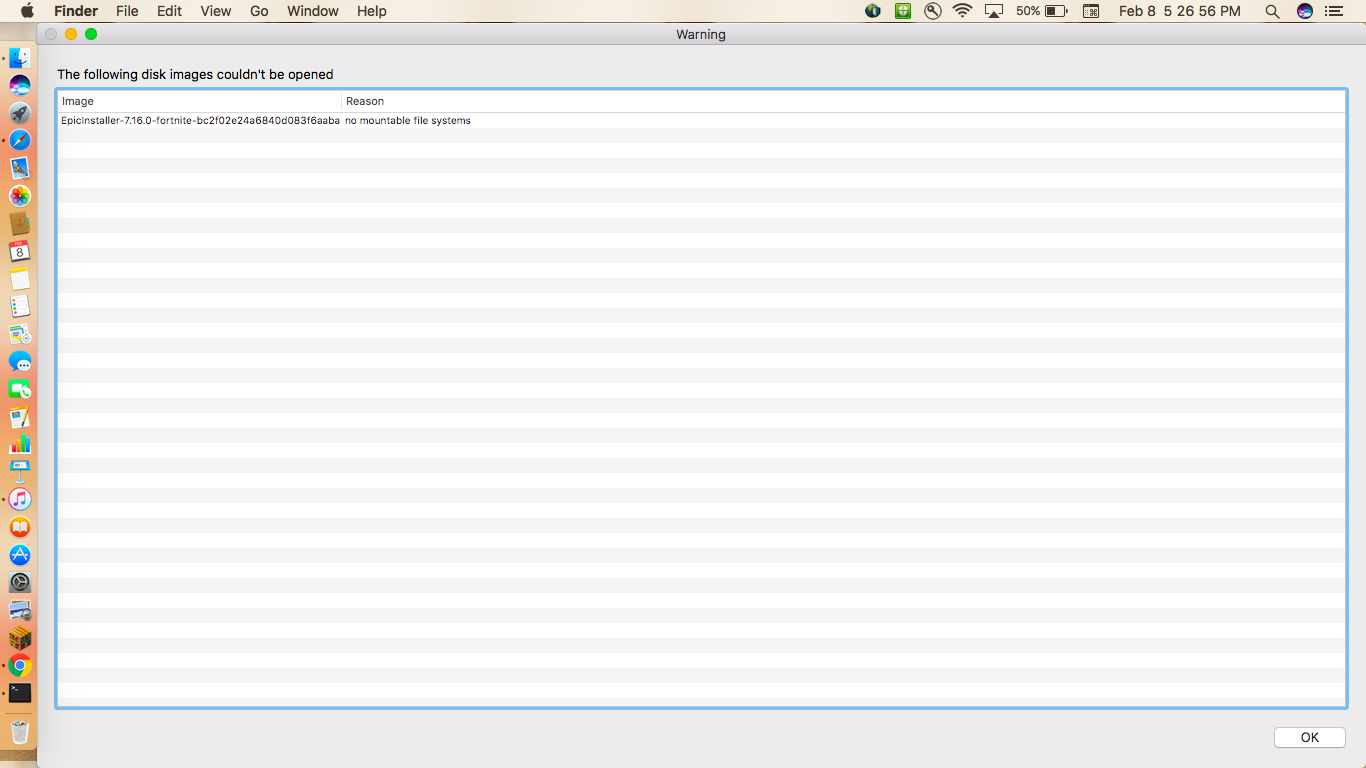
I downloaded the installer for Prism Mac, but when I double click I get a message: 'no mountable file systems'. Last modified January 1, 2009 The installer for Prism Mac 5 comes as a DMG file. Several day ago it was OK, I installed several updates, rebooted my Mac couple of times and now something that worked before was rejected. The same result “no mountable file systems” I got when I double clicked on DMG file on Finder windows or when I executed hdiutil command. I have not been able to use DP since the 2.0.6 update; every time I open up the mac file, I get a message stating: no mountable file systems. This also goes for the newest update 2.0.7. I have already re-downloaded the files more than on. If all of that seems to be fine, see if you can open the dmg in safe mode. If opening the dmg in safe mode did the trick, you can keep following the posts in the linked guide to see how to inspect your system modifications to try to figure out what's causing your computer to fail to mount the dmg normally.
No Mountable File Systems Dmg Mac Fix
May 8th, 2003 | ||
| ||
Hey I came here looking for help and found none..But I didn't give up hope just looked else were...My problem was I could not mount dmg's, cds, zip disks, ect .Any way the solution i found was this. (5). After doing some more research on this problem, I came across this post on another forum which indicated this may be a problem with the unknown user on your OS X system. The unknown user is one of those hidden Ids, like root, that has special UNIX functions. Eric Wing (another Helper) and I developed the following procedure for checking and recreating the unknown user if yours is missing. Verify the existence of the unknown user: There are two ways to check your system to determine if the unknown user is missing: A. With NetInfo Manager 1. Open NetInfo Manager (in the Computer > Mac OS X > Applications > Utilities folder) 2. In the middle column of the resulting window, select (click once) on users. 3. The column just to the right should fill with the list of users. See if unknown appears in the list. B. 'Get Info' method 1. Select any file, preferably one you own (otherwise you'll need to authenticate first). 2. Perform a Get Info (Command+I or Apple+I) key combination on the file. 3. Select the disclosure triangle for Ownership and Permissions panel. 4. Click the Lock icon. 5. Click the double arrowhead next to the 'Owner: owner_name' field. 6. In the resulting list, unknown should appear in the list of potential owners. To recreate the unknown user: 1. Open NetInfo Manager. 2. Click the Lock icon in the bottom left hand corner of the window to authenticate, and authenticate. 3. In the middle column, select users. The column just to the right should fill with the list of users. 4. Highlight/select nobody 5. Under the Edit menu, select Duplicate; or press the key combination Command+D (Apple+D). This will create a new user, nobody copy. 6. Select the newly created user, nobody copy. 7. In the bottom half of the split screen, you'll see Properties and Values for nobody copy. You'll need to edit some of the Values for nobody copy to make them what they should be for unknown -- this will 'convert' nobody copy into unknown. The following are the default values for unknown: Property Values expire 0 realname Unknown User name unknown passwd * uid 99 _writers_passwd unknown change 0 shell /dev/null home /dev/null gid 99 8. Change the following Property values to the values shown in the table in step 7: realname, name, uid, _writers_passwd, gid. Do so by double-clicking on the Values for those propteries and edit the contents with the values for unknown in step 7. 9. In the menu bar, select Domain > Save Changes. 10. Agree to Update the copy of the database if you're sure of your editing. 11. You should now see that nobody copy is now unknown 12. Quit NetInfoManager. You should probably Restart at this point. |